From Screening to Lifesaving Care: How Early Check Is Transforming Newborn Health in North Carolina

Each year, babies are born with rare genetic conditions that may not show symptoms right away but can lead to irreversible harm if left untreated. Traditional newborn screening identifies only a limited number of these conditions, leaving many families without answers until after damage has already occurred. Addressing this gap requires more than new technology. It requires a way to bring scientific advances into real-world public health systems, equitably and at scale.
The North Carolina Translational and Clinical Sciences (TraCS) Institute is the NIH-funded CTSA Hub at UNC-Chapel Hill. TraCS helped bring together academic researchers, clinicians, and public health partners and provided the translational framework to move genomic screening from concept to implementation in a new program called “Early Check.”
Early Check was successful right from the start, and resulted in life-saving work, by enabling the early diagnosis of spinal muscular atrophy (SMA), a condition that is fatal without timely treatment, and informing statewide policy. As a result, since May 2021, every baby born in the state of North Carolina is screened for SMA, enabling treatment to start immediately.
The Approach: Translating Genomic Science into Public Health Practice
Led by a statewide partnership among RTI International, the North Carolina Division of Public Health, and researchers at the University of North Carolina at Chapel Hill, Duke University, and Wake Forest University, the program tested whether newborn screening could be expanded using existing infrastructure.
Instead of requiring new procedures, Early Check used leftover dried blood spots from routine newborn screening. Parents could voluntarily enroll online, allowing their newborns to be screened for additional rare but treatable conditions, at no cost. The program also piloted advanced tools like whole-genome sequencing, capable of identifying more than 200 conditions at once. With TraCS driving the translational strategy, the study was designed not just to test a technology—but to evaluate how it could work within a real statewide system.
The Evidence: Showing Expanded Screening Works in the Real World
Between September 2023 and October 2025, Early Check enrolled 5,744 newborns across North Carolina.
The results demonstrated that expanded genomic screening is both feasible and effective at scale:
-
- 93% screening success rate using existing dried blood spots
-
- 139 infants (2.5%) flagged for follow-up, leading to diagnoses of rare genetic conditions
-
- 210 infants identified with elevated risk for type 1 diabetes, enabling early monitoring
By integrating research into routine systems, Early Check generated practice-ready evidence, a hallmark of CTSA-supported translational science.
The Impact: Changing Outcomes for Children and Families
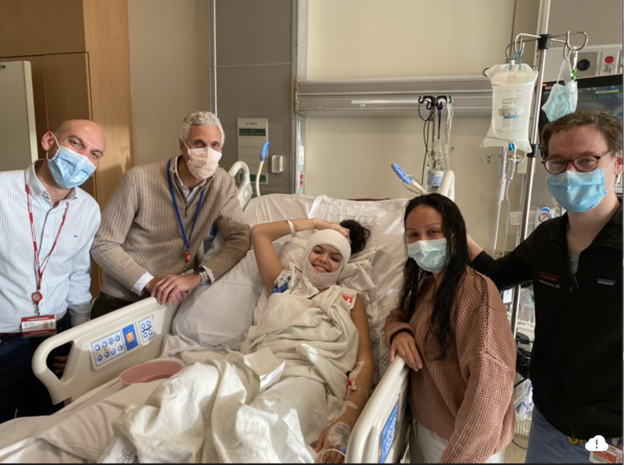
Behind these numbers are life-changing stories.
Early Check enabled the early diagnosis of spinal muscular atrophy (SMA), a condition that can be fatal without timely treatment.
-
-
One infant received gene therapy at just eight weeks old and achieved developmental milestones that might otherwise have been out of reach.
-
-
- Two sisters diagnosed at birth were treated early and now run and play alongside their peers.
These outcomes underscore a powerful truth: when detected early, some of the most severe genetic conditions can be treated before symptoms ever begin.
From Research to Policy: Turning Evidence into Standard Care
TraCS and the CTSA Consortium propelled Early Check beyond feasibility, producing the evidence that informed statewide policy.
This progression—from research study to statewide policy—illustrates the core mission of TraCS: accelerating discoveries into practices that improve population health.
Why It Matters: A Blueprint for the Future
Early Check offers a model for how genomic innovations can be translated into public health impact:
-
- Use existing infrastructure to expand care without adding burden
-
- Apply translational science frameworks to move from discovery to implementation
-
- Engage families through accessible, voluntary participation
-
- Generate evidence that informs policy and standard practice
By connecting research, clinical care, and public health systems, TraCS helped ensure that advances in genomic science reach the families who need them most.
As new treatments for rare diseases continue to emerge, Early Check demonstrates what is possible when translational science is designed with impact in mind and gives more children the chance for a healthier future from the very start.
Early Check transformed genomic screening from a research innovation into a scalable public health solution; ultimately changing how and when life-saving care begins.