From Living Tissue to Precision Treatment: How SLiCE Is Transforming Brain Cancer Research

The Challenge
Glioblastoma is one of the deadliest cancers, with fewer than 10% of adults surviving more than five years. Despite decades of research, treatment options have barely changed. A major barrier has been the lack of models that accurately reflect how tumors behave in the human brain. Tumor cells grown in laboratory dishes often lose their structure and function, and animal models can take months without reliably predicting patient response. Without realistic systems to test therapies, researchers and clinicians have struggled to identify which treatments will work for individual patients.
The Translational Innovation
At the University of North Carolina at Chapel Hill, researchers developed SLiCE (Screening Live Cancer Explants), a platform that keeps patient tumor samples alive on living tissue, preserving their natural behavior.
SLiCE bridges the gap between traditional lab models and human biology by:
- Maintaining tumors in a realistic, living microenvironment
- Enabling multi-drug testing directly on patient tissue
- Delivering results in as little as four days
This approach creates a powerful new capability: testing how an individual patient’s tumor responds to therapy before treatment decisions are made.
The Role of TraCS and the CTSA Hub
The success of SLiCE is rooted in the North Carolina Translational and Clinical Sciences (NC TraCS) Institute, UNC’s CTSA Hub. Through CTSA-supported translational training and infrastructure, TraCS enabled the SLiCE team to move from concept to impact:
Training the translational workforce
- Drs. Andrew Satterlee and Shawn Hingtgen participated in TL1 and K12 programs, gaining skills to connect laboratory discovery with clinical application
- This training fostered a mindset focused on solving real patient problems—not just advancing basic science
Advancing team science and collaboration
- TraCS support helped catalyze multi-disciplinary and multi-institutional partnerships, including work with Nobel laureate Aziz Sancar
Providing infrastructure for scale
- SLiCE has evolved into a UNC core facility, expanding access to researchers and accelerating preclinical testing across studies
Leveraging national CTSA resources
- The project secured NCATS U01 funding, enabling broader development and positioning the technology for use across neurological diseases
Together, these elements illustrate how the CTSA Hub model supports innovation across the full translational spectrum—from early discovery to real-world application.
From Platform to Breakthrough
SLiCE has already demonstrated its value in advancing therapeutic discovery. In collaboration with Nobel laureate Aziz Sancar, researchers used SLiCE to test EdU, a compound traditionally used to track cell division. Sancar’s lab discovered that EdU can cross the blood–brain barrier and kill cancer cells.
Using the SLiCE platform:
- EdU was tested directly on patient glioblastoma tumors
- It outperformed the current standard therapy (temozolomide) in multiple samples
- Combination studies revealed potential for enhanced tumor killing with existing drugs
These findings led to rapid publications and highlight how SLiCE accelerates the path from discovery to therapeutic insight.
Impact on Patients and Science
SLiCE is helping drive a shift toward functional precision medicine—where treatment decisions are based on how a patient’s tumor responds, not just on genetic or imaging data.
In the future, this approach could enable:
- Testing therapies on a patient’s tumor immediately after surgery
- Identifying the most effective treatment within days
- Avoiding ineffective therapies and unnecessary side effects
Beyond brain cancer, SLiCE is being adapted for other neurological diseases, expanding its potential impact across multiple conditions.
Why This Matters for Translational Science
SLiCE exemplifies the CTSA model in action:
- A clinical need drives innovation
- Translational training equips scientists to address that need
- Collaborative infrastructure accelerates development
- Cross-disciplinary partnerships enable breakthroughs
- Patients stand to benefit from faster, more precise care
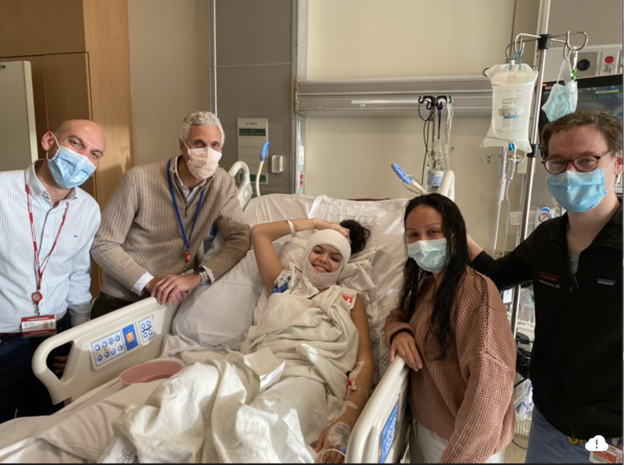
As Dr. Andrew Satterlee—himself a brain cancer survivor—recognized early on, better tools are essential for better decisions. Today, SLiCE is becoming that tool.
The Bottom Line
With support from TraCS, NCATS, and the CTSA program, SLiCE demonstrates how investing in translational science can:
- Transform how diseases are studied
- Accelerate therapeutic discovery
- Bring personalized treatment closer to reality
For patients with glioblastoma, it represents something critically needed: a faster path to the right treatment and renewed hope.